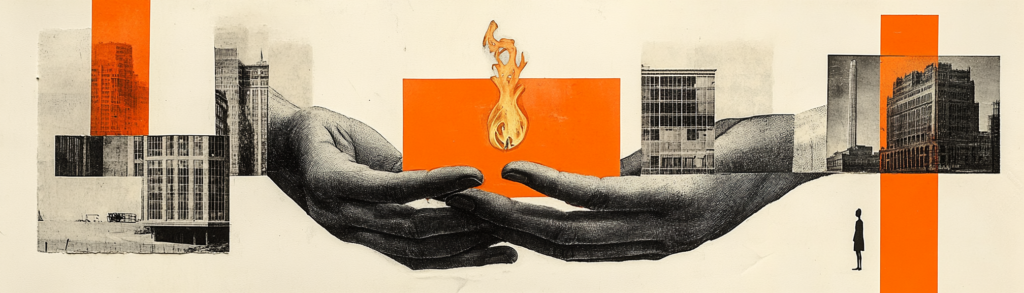

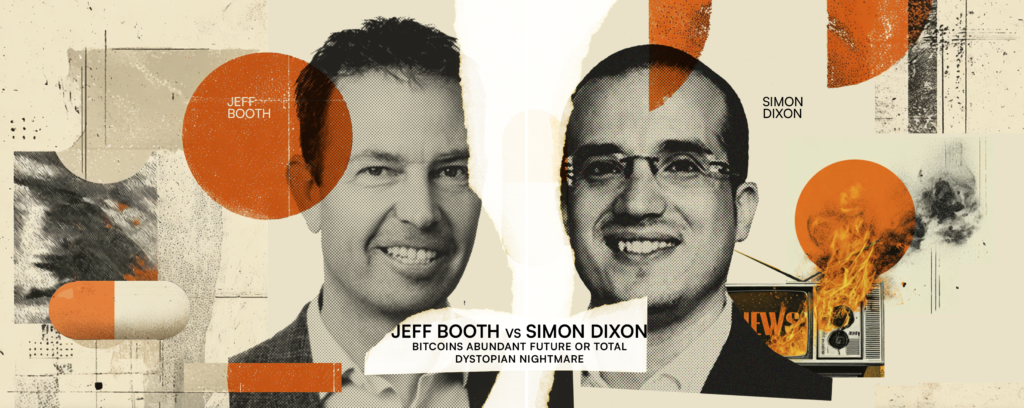
The recent conversation between Jeff Booth and Simon Dixon on BTC Sessions is being framed as a debate between optimism and caution. Abundance versus survival. Freedom versus a surveillance state. But listening closely, it feels like both men are circling something older, deeper, and more permanent than Bitcoin itself. If you haven’t listened, you should. Do it here.
They are both describing different reactions to the same reality.
Simon Dixon sees a future where technology and finance are fused into a control system that most people will never escape. Programmable money. Behavioral compliance. A small group of Bitcoiners may preserve autonomy through Bitcoin self-custody, but the majority will remain trapped inside an Orwellian framework they didn’t consent to but rely on for comfort and survival.
Jeff Booth, on the other hand, believes Bitcoin represents an unstoppable force. That free markets, honest money, and layered privacy infrastructure will eventually dismantle centralized control. That abundance, not domination, is the natural end state once monetary theft is removed from the system.
Both perspectives are compelling. And both, in my view, miss a foundational truth.
There have always been two systems: public and private
Public and private.
Visible and invisible.
Servant and steward.
Empire and sanctuary.
This isn’t political theory. It’s natural law. Even spiritual law, if you’re inclined to see it that way. Scripture itself tells us the poor will always be among us. Hierarchies persist across civilizations. Elites and laborers. Rulers and the ruled. Not because one system failed, but because duality is how the world actually operates.
The mistake is believing one side will ever eliminate the other.
For generations, the elite understood this. They didn’t wait for a perfect system to arrive. These aren’t relics of old money. They’re tools available to anyone willing to step into the private system. Layered ownership. Delegated authority. They moved through the public realm without being exposed to it, limiting liability while retaining control. They lived privately as individuals while their structures interacted publicly on their behalf.
Meanwhile, everyone else was taught that privacy meant secrecy, or that freedom came from demanding rights inside the public system. Constitutions. Courts. Voting booths. All important conversations, but all happening entirely inside the public layer.
Bitcoin privacy was never just about being unseen online.
The public system doesn’t collapse.
It entices.
This is where Simon Dixon is closer to the truth. Control systems don’t vanish. They evolve. They rebrand. They get more efficient. But where his view stops short is assuming the outcome is universal imprisonment, with only a small escape hatch for a technical elite.
There has always been another path.
Not rebellion. Not revolution. But separation.
Bitcoin teaches this better than anything else in modern life. You don’t overthrow the banking system. You route around it. You don’t beg for permission. You take self-custody. You don’t demand fairness. You remove exposure.
Bitcoin doesn’t overthrow the system—
it teaches you how to protect yourself and route around it.
But Bitcoin is the entry point. Asset protection is the path.
What Jeff Booth gestures toward when he speaks of free markets isn’t a future political system. It’s a state of being most people have never experienced. Living without constant interference. Without administrative overreach. Without fiat distortions. It feels unimaginable because almost all of us have only ever lived publicly.
We don’t know what it feels like to structure our lives privately.
Living in the world, but not of the world. Interacting with the financial system, but not being owned by it. Using public tools without becoming public property.ng public property.
That’s the third perspective missing from the Booth, Dixon debate. Hidden in plain sight.
The future won’t be one system defeating the other. It will be what it has always been. A public realm that grows louder, more intrusive, more enticing. And a private realm — built on sovereign asset protection — quietly operating alongside it for those who learn how to enter it.
The question isn’t whether control is coming.
It’s whether you know how to move when it does.
Bitcoin shows you that it’s possible.
The private shows you how.
And that distinction between private and public makes all the difference.
This is our specialty. Understanding the principles beneath the noise—and using them as a lens to move through what’s coming without panic or reaction. Control systems rise and fall, but the private and the public remain. Knowing how to distinguish between them, and how to structure your assets lawfully and deliberately within both, is what creates real peace of mind. If you want to learn how to build that kind of private asset protection, we can show you the way.
And that distinction makes all the difference.
Which system are you operating in? Book a consultation to find out — and learn how irrevocable trust structures can move your Bitcoin and your life into the private.