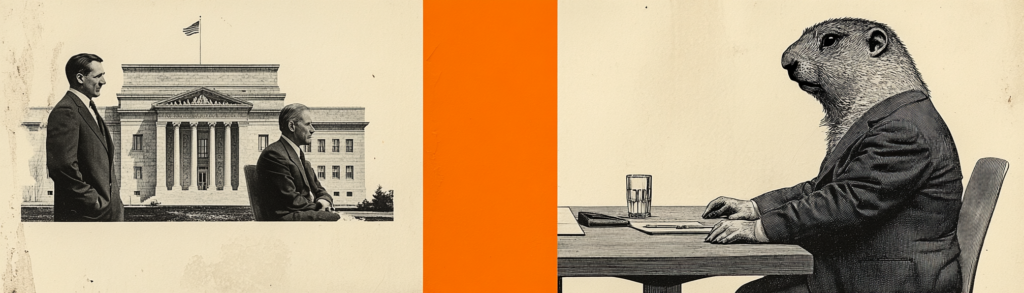

There is a compelling vision circulating in sound money circles.
That Bitcoin’s deflationary architecture will incrementally absorb the fiat system. That the incentives are so perfectly aligned that adoption isn’t just likely — it’s inevitable. That freedom wins. That the private, decentralized, self-sovereign model will eventually replace what replaced the gold standard.
It’s a serious argument made by serious thinkers. And at one level it’s probably right.
But there’s a question nobody is asking underneath it.
Even if that’s true — then what
Even if Bitcoin absorbs fiat. Even if the monetary system is rebuilt on sound money. Even if every central bank becomes irrelevant and every fiat instrument is eventually measured against something that cannot be debased.
Does that resolve the tension between public and private?
Does it dissolve the separation between the seen and the unseen? Between what is administered and what is sovereign? Between what is temporary and what endures?
The honest answer is no.
And understanding why changes everything about how you approach the next decade — and every decade after it.
Two realms are not a monetary problem
The public and private realms didn’t originate in a central bank.
They predate every financial system ever built. They predate every government, every court, every ledger. They are a feature of existence itself — not a bug introduced by bad monetary policy and not a problem to be patched by better money.
We explored this in the last piece. The oldest wisdom traditions agree on something modern life has mostly forgotten. The visible world was shaped by forces that precede it. What governs a thing is rarely the thing you can see. It’s the architecture underneath.
Public and private. Seen and unseen. Administered and sovereign. These are not monetary categories. They are ontological ones. They describe the structure of reality itself — and they have operated in tension since long before the first coin was struck.
Natural law doesn’t resolve because the ledger is immutable. The tension between the two realms is not a financial phenomenon. It runs deeper than that.
The garden
Every wisdom tradition points to the same origin state.
One realm. No separation. No need for legal structures to protect what was already whole. No need for private trusts to separate what had never been exposed. No need for sound money to preserve what had never been debased.
The split wasn’t a monetary decision. It wasn’t a policy failure or an institutional betrayal. It was deeper than that. And the restoration — if it comes — won’t be a monetary event either.
The garden is not a Bitcoin whitepaper.
It never was.
To expect a financial instrument — however extraordinary — to restore what was lost at a level that precedes finance is to misunderstand both the instrument and the loss. It places a weight on Bitcoin that Bitcoin was never designed to carry. And more importantly it places a hope in a system that belongs in a different category entirely.
The garden is the only resolution to the tension between the two realms. Everything before that is navigation.
The paradox of Bitcoin’s power
Here is where it gets genuinely interesting.
Bitcoin’s extraordinary power comes precisely from what it refuses to become.
It is sovereign because it is separate. It protects because it doesn’t consolidate. It enables the private realm because it cannot be administered. Its scarcity is mathematical not political. Its rules change for no one. It answers to no institution, no government, no central authority.
That is not a feature of a system designed to take over. That is a feature of a system designed to remain apart.
And this is the paradox the maximalist vision doesn’t fully reckon with.
If Bitcoin wins by becoming the new dominant global reserve currency — managed by institutions, held by central banks, integrated into the same administrative framework it was born to circumvent — then Bitcoin has crossed into the public realm. It has surrendered the very property that made it valuable. The conquest is the defeat.
A Bitcoin that wins by becoming the new fiat is a Bitcoin that has lost.
Its power is not in its conquest. It is in its refusal.
What Bitcoin actually is
Bitcoin is the best sound money tool ever created for navigating a world that will always have two realms.
That is an extraordinary thing to be. Read it again.
It is the private realm’s money. Self-custodied, sovereign, separate from the administrative systems that have historically reached into every corner of private life. It is backed by mathematics instead of decree. It settles peer to peer, finally and irreversibly. It cannot be recalled, debased, or redirected by institutions that depend on your participation.
In a world where two realms are permanent — where the tension between public and private, temporary and enduring, seen and unseen is a feature of existence rather than a problem to be solved — Bitcoin is the most honest tool available for building on the side that lasts.
That is not a small thing. That is everything.
It doesn’t need to be more. Asking Bitcoin to be the garden is asking it to be something it was never designed to be — and something that would require it to betray everything that makes it what it is.
The instrument is perfect for its actual purpose. Let it be that.
The practical conclusion
So what do you do with this?
You stop waiting for the system to resolve before you start living deliberately.
You stack sats — not because Bitcoin is going to save the world, but because it is the most honest private money ever created for building inside a world that will always have two realms.
You build your trust structures. You separate your exposure. You move assets from the visible into the private — into structures that the public system cannot easily reach, redirect, or dissolve.
You operate in both realms with wisdom and intention. You use the public realm for what it offers. You build your foundation in the private realm on what endures.
You use Bitcoin for what it actually is — the hardest sound money ever created, perfectly suited to the private realm — and you let that be enough.
Because it is more than enough.
The maximalist is right about Bitcoin.
He’s just wrong about what Bitcoin is for.
The only true restoration
Two realms will always exist on this side of restoration.
The public will always be loud, visible, fragile, and managed. The private will always be quiet, sovereign, separate, and enduring. The tension between them is not a problem to be solved by any financial instrument — however revolutionary.
The only resolution is the garden. And the garden is not coming through a blockchain.
Until then — and it may be a long until — the wisest move is the one the wisest people across every generation have made.
Learn the structure of the world you’re actually in. Build deliberately on the layer that lasts. Use the best tools available for the realm they were designed to serve.
Bitcoin is that tool for the private realm. It is extraordinary at what it does. It doesn’t need to do everything.
That’s not a limitation.
That’s its power.
Ready to align your structure with your principles? Book a consultation to learn how irrevocable trusts, Bitcoin self-custody, and private asset protection can move your wealth from the temporary to the enduring.